Nakakita
A ManNakakita is Kido’s senior partner and closest sounding board at the law firm: a genial, music-loving lawyer whose loyalty is expressed through practical work and candid questions. He assists Kido in supporting people affected by the Great East Japan Earthquake, helps set in motion a crucial lead in the search for Daisuké Taniguchi, and later challenges Kido’s assumptions about Misuzu. His role is more than that of a helpful colleague: he repeatedly makes Kido look again at the distance between what can be known about another person and what affection encourages him to believe.
Identity and Background
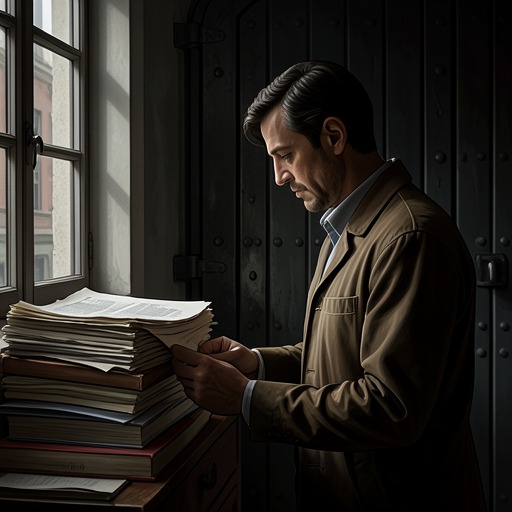
Some years Kido’s senior, Nakakita has an easy, elder-brother quality that inspires both respect and fondness. A sparse, downy shadow on his sunken cheeks gives him an allure Kido considers distinctly un-lawyerly, and his life outside the firm includes family responsibilities and playing drums in a band. The band works in the style of The Gadd Gang; Kido, who played bass in university, has gone to hear them several times. Nakakita’s steady drumming, which Kido hears as full of personality, helps explain the immediate affinity between the two men. When Kido was establishing the firm, Nakakita was the first person he approached.
His legal temperament combines sociability with a stubborn attachment to the letter of the law. Although he likes criminal cases and continues taking many on as he grows older, he does not let tragic circumstances displace legal standards. That combination—personal warmth alongside professional exactness—also shapes his conversations with Kido: Nakakita listens closely, but does not simply endorse whatever Kido wants to believe.
Work and Counsel
Nakakita’s work extends beyond the firm’s ordinary caseload. After the earthquake and tsunami, he coordinated with Kido and the other partners to volunteer legal support for people affected by the disaster. Their assistance included cases involving voluntary evacuees from areas with elevated radiation levels around the Fukushima Daiichi Nuclear Power Plant. Some evacuees sought to move from government-provided temporary housing because of its poor condition, local disturbances, or harassment. Yet leaving could cost them housing coverage unless they met restrictive requirements. Lawyers were needed to help people navigate those bureaucratic barriers, and Nakakita’s involvement helped place the firm in contact with problems the official system did not readily see.
At lunch in Chinatown, after Kido had argued a civil case at the Yokohama District Court, Nakakita turns their conversation from the proceeding to the Miyazaki case. Kido tells him that the death and marriage notifications for the man who was impersonated have been annulled. Nakakita recognizes the practical limit of that result, replying that this may be about all that can be done. The exchange shows the restrained, procedural side of his counsel: he understands the legal consequence without pretending it can undo the human history behind it.
Nakakita also gives Kido room to speak about burdens that are not strictly professional. When he asks about a death-by-overwork suit, Kido explains that a restaurant employee’s family is suing after the twenty-seven-year-old killed himself following an unconscionably long shift. The first hearing is still ahead, in October, while Kido is recording accounts from the parties; among roughly fifty cases he is handling, this one is particularly draining. Kido admits that he manages only by reminding himself that the case does not involve him personally. Nakakita calls that a basic truth of the job, then asks whether Kido went anywhere the previous summer. Instead of keeping his usual silence about his personal life, Kido blurts out that things at home are not going well. The unexpected admission leaves Nakakita wide-eyed, revealing the trust that underlies their professional friendship.
A Lead in the Search
Nakakita’s support for earthquake survivors gives Kido an unexpected way forward when his investigation into X has stalled. More than ten months into Rié’s case, Kido has made no progress identifying the impersonator. The fake account run by Misuzu and Kyoichi has not produced a breakthrough, and, with Rié’s family register revised and the urgent legal matters settled, Kido is unsure how to continue.
At the firm, Nakakita has been consulted about tsunami victims whose existence the government could not track because they lacked a family register. The problem leads into the three-hundred-day rule: a child born within three hundred days of a divorce is legally treated as the former husband’s child, and some women in difficult circumstances have avoided registering a birth after having a child with a new partner. Nakakita tells Kido about a case involving this issue. The predicament is especially stark after a disaster: a child without a register may be absent from official records of both life and death, and if the tsunami has carried the child away, physical evidence may be gone as well. This account sharpens Kido’s fear that the missing Daisuké may not be alive, even as he tries not to believe that X killed him.
The two men discuss the family register’s history over coffee on the office couch. Nakakita traces its uses from the Ritsuryo-era bureaucracy through the Edo period, when records of religious affiliation helped enforce registration with Buddhist temples, and into the modern system shaped by conscription and taxation. He also points to the register’s role in Japan’s assimilation policies on the Korean Peninsula, acknowledging Kido’s heritage as he criticizes those policies. Kido observes that people excluded from the register could become second-class citizens, while Nakakita notes that residence certificates and the My Number system may eventually make the register redundant. Kido counters that identity exchange might then become easier—a concern that turns their historical conversation toward his current investigation.
Following this discussion, Kido researches criminal cases involving social security and finds the 2007 Adachi Ward family-register exchange case. A fifty-five-year-old man had impersonated a sixty-seven-year-old to collect his pension, but the arrangement was a mutually agreed register swap: the older man wanted to appear ten years younger and never married to his fiancée. The ruling also identified a broker who had arranged other exchanges for a fee. The case gives Kido a path toward the identity-broker network relevant to X. Nakakita does not solve the case for him; his account of a contemporary registration problem and their historical discussion instead furnish the question that sends Kido looking in a new direction.
Skepticism and Friendship
Nakakita’s part in the investigation continues through the postcards Kido receives from Omiura. One drawing identifies Daisuké Taniguchi and Yoshihiko Sonézaki by writing their names around the breasts of an exaggerated manga-style woman. Kido shows the postcard to Nakakita without comment. Nakakita frowns over it, then breaks into exasperated laughter, interpreting the clue as Omiura’s suggestion that Yoshihiko Sonézaki is X. Kido agrees that this is how it appears, while admitting he has never encountered the name before. Nakakita’s reaction makes the exchange feel at once absurd and useful: the information arrives in an indecorous form, but the two lawyers can still extract a lead from it.
Later, when Kido tells Nakakita that Misuzu is helping search for Daisuké, Nakakita is incredulous. He cautions that Misuzu is Daisuké’s former partner and asks Kido to consider the possibility that she is pursuing him, or that Daisuké left to escape her. The story Kido has heard—that Daisuké abandoned his register after falling out with his family—may be incomplete. Nakakita does not claim that Misuzu is lying; he insists that Kido has no reliable basis for ruling the possibility out.
The warning unsettles Kido because it strikes at the certainty of his feelings. He has no answer that can justify his conduct, and Nakakita’s alternative account casts a shadow over the image of Misuzu that has held Kido’s heart for the past year. The challenge resonates with the investigation itself: another person’s past cannot be recovered whole, and even someone standing directly before Kido may remain opaque to him. Nakakita’s skepticism is thus neither simple suspicion nor a rejection of intimacy. It is a demand that Kido distinguish a compelling impression from established knowledge.
Narrative Role
Nakakita repeatedly connects private feeling to public systems. His disaster-relief work exposes the human consequences of rules that make some lives difficult to register; his discussion of the family register turns those consequences into a route toward Kido’s investigation; and his warning about Misuzu brings the problem of uncertain identity back into Kido’s personal life. Each intervention is grounded in their ordinary friendship—lunch, coffee, a postcard shown without explanation, a question at the office—rather than in any claim to omniscience.
He also recognizes Kido’s distress before Kido is ready to explain it. As Kido heads back to his desk after their difficult exchange about Misuzu, Nakakita asks whether he is all right. The question echoes one Kaori has asked Kido, and Kido’s eyes widen at the repetition. He forces a smile and asks why Nakakita wants to know. The moment does not resolve Kido’s home troubles, but it shows that his colleague is attentive to the person behind the lawyer. Nakakita’s steadiness therefore serves as both professional support and a modest check on Kido’s isolation: he offers help, but also asks the question that makes self-deception harder to sustain.